
Guides
Rift-sawn vs. plain-sawn white oak
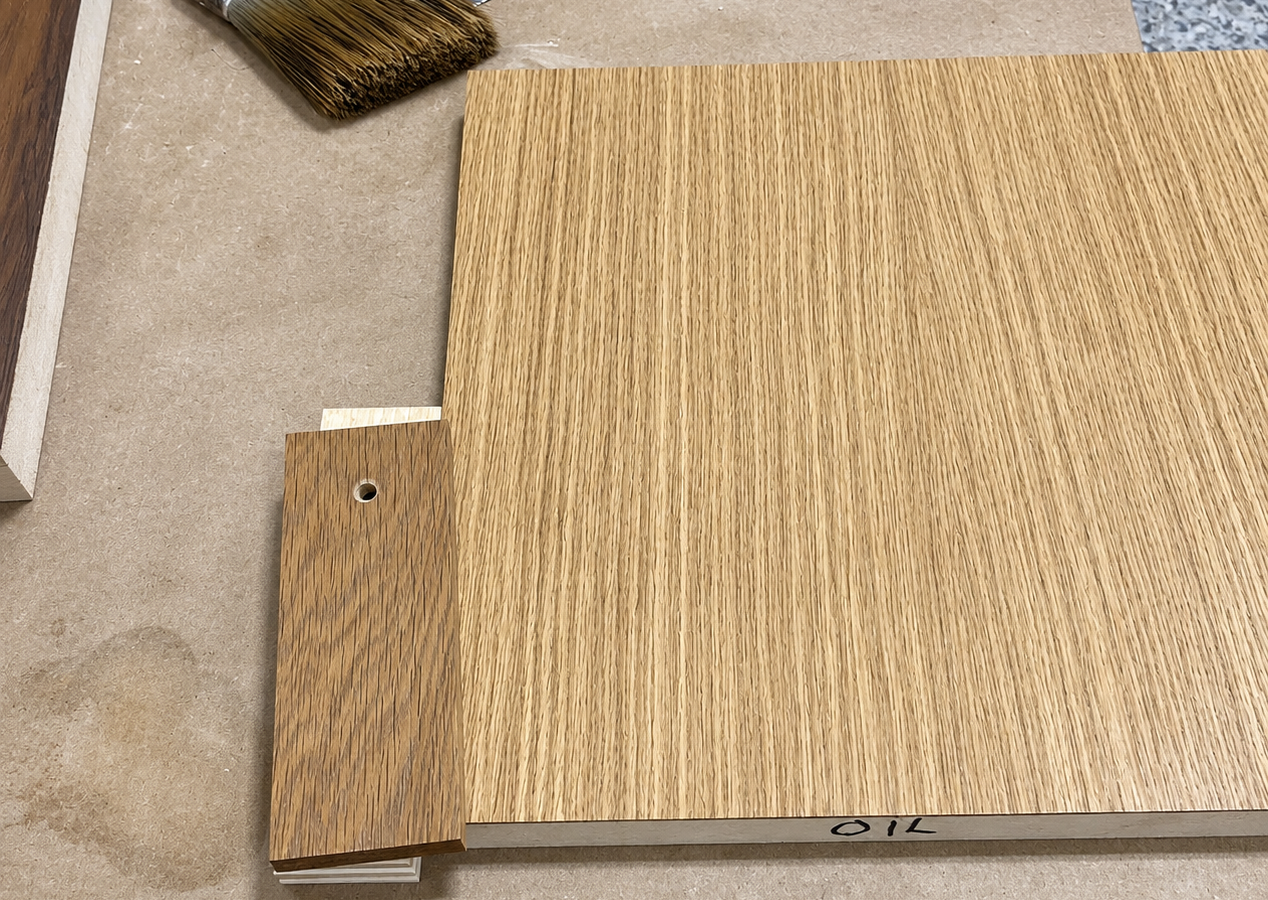
White oak is one of the most requested woods in our workshop, and one of the first questions it raises is which cut. Rift-sawn and plain-sawn oak can come from the same tree, yet they look like two different materials. One is calm, straight and architectural. The other is lively, with the arching figure most people picture when they think of oak. The difference comes down to how the log is cut.
How the log is cut
A log is made of growth rings, one for each year of the tree’s life. How a board is cut relative to those rings decides what its face looks like.
- Plain-sawn (also called flat-sawn) boards are cut straight through the log, roughly parallel to the growth rings. The rings meet the face of the board at a shallow angle, and they show as wide, arching patterns often called cathedrals. It is the most efficient way to cut a log, with the least waste.
- Rift-sawn boards are cut so the growth rings meet the face at a steep angle, roughly between 30 and 60 degrees. The rings show as tight, straight, parallel lines running the length of the board. Getting that angle means cutting the log in a way that produces far less usable material, which is a large part of why rift oak costs more.
- Quartersawn oak sits between the two. The rings meet the face at close to 90 degrees, which exposes oak’s medullary rays as shimmering flecks across the grain. It’s a beautiful look, but a more traditional one, and it’s not what most people mean when they ask for rift.
Most of the oak in our work is veneer, sliced thin from the log and laid on stable cores. The same principles apply. Rift-cut veneer gives the straight, linear grain, and plain-sliced veneer gives the cathedral figure.
Straight grain vs. cathedral grain
The two cuts set a very different tone in a room.
Rift oak reads as quiet and precise. The grain runs in straight, even lines, so a wall of cabinetry looks continuous, and the eye goes to proportion, reveals and light rather than to the wood itself. Because there’s little variation from board to board, rift is easier to match across long runs of doors and panels. That’s why it suits modern and minimal interiors so well.
Plain-sawn oak has more movement and character. The cathedrals give each panel its own pattern, which brings warmth and a more traditional or rustic feel. Used well, it can be the feature of a room. Used across a large wall of doors, it can feel busy unless the panels are carefully selected and laid out.
There’s a practical difference too. Rift-sawn lumber is more stable than plain-sawn: it is less prone to cupping and seasonal movement. In veneer work on engineered cores, stability comes mostly from the core, so the choice is driven more by look than by movement.
Where each belongs
There’s no single right answer, but some patterns hold up across our projects.
- Kitchens: rift oak is the most common choice for contemporary kitchens. Long runs of doors and panels read as one surface, and the straight grain works with clean stone and integrated appliances. The Rift Oak Kitchen is a good example.
- Libraries and built-ins: either can work. Rift keeps a large bookcase wall calm behind the books. Plain-sawn gives a warmer, more traditional library, especially with a darker finish.
- Wall paneling and feature walls: rift gives the cleanest continuous wall, with grain that can run unbroken across doors and panels. In the Carved Oak Residence, rift oak gave a quiet base for the carved line pattern, so the carving, not the grain, became the feature.
- Furniture-scale pieces: a single credenza or vanity front is where plain-sawn figure can shine, because each panel can be selected for its pattern.
Matching makes the difference
Whichever cut you choose, how the veneer is matched matters as much as the species. Veneer leaves are laid out in sequence: slip-matched for a repeating, linear look, or book-matched for a mirrored pattern. Panels are then sequenced across doors so the grain flows from one to the next. On a rift oak wall, careful matching is what makes twenty doors read as one surface. We plan the grain direction and matching in the shop drawings, and you see it in the samples before anything is built.
Beyond oak
Oak isn’t the only wood that works this way. Walnut offers a darker, richer alternative, with its own straight-grained and figured cuts. Quartered fir gives a tight, vertical grain with a softer, warmer tone, as in the library details of the Upper West Side Residence. The same questions apply to any species: how was it cut, how will it be matched, and what should the room feel like?
Choosing for your project
The best way to choose is to see both side by side, in your finish and under your light. Samples are part of every commission, and the signed sample becomes the standard for the finished work. If you’re weighing rift against plain-sawn oak for a kitchen, library or paneled room, send us your drawings or a description and photos of your space, and we’ll talk it through.
Planning a kitchen?
Share your drawings and timeline, and we'll reply within two business days.